
Undoubtedly, your Lord will provide for you, and you will be content.
Duha /5
Ramadan is a source of hope for all believers. This hope begins with intention. First, a person intends to mend their relationship with Allah; subsequently, all relationships are reorganized. A person’s intention changes their direction, and their direction changes their ultimate destination. A person revives hope within themselves and rebuilds all relationships.
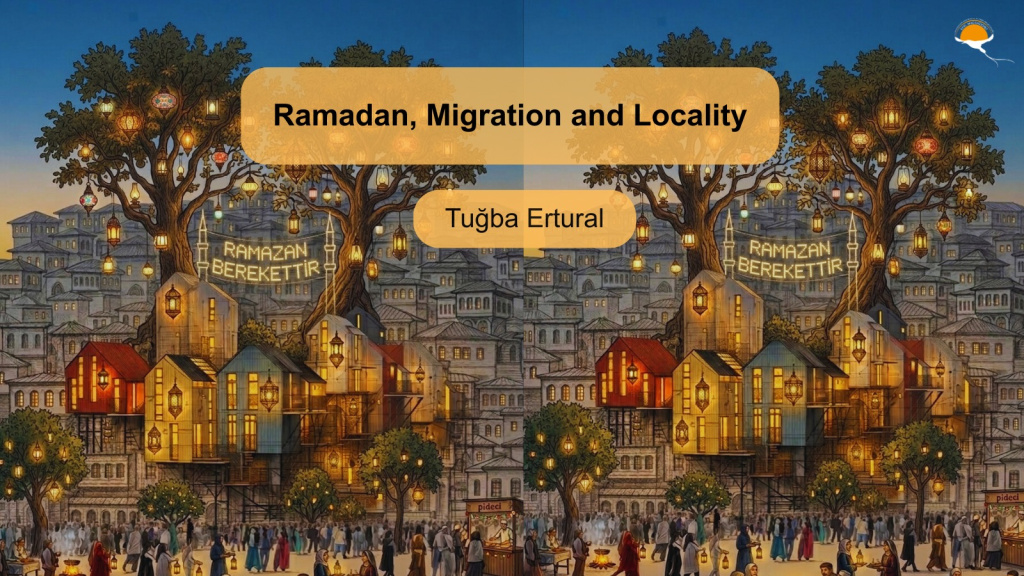
As a person rebuilds their relationships, they also forge a new connection with the space they inhabit. The month of Ramadan fosters a transformation felt not only within the human soul but also in the streets, squares, and mosque courtyards. The iftar tables set up, the shared bread, and the crowds awaiting the same call to prayer reveal moments when the space regains meaning alongside the people. Architecture comes into play precisely here; for a space becomes a living memory to the extent that it allows people to come together.
When Ramadan arrives, the rhythm of cities changes. Streets that grow quiet during the day come alive again as iftar time approaches. The scent of warm flatbread rising from bakeries, people waiting in mosque courtyards, light spilling from balconies onto the street… Ramadan is not merely a period of time, but a shared spatial experience established within the city.
The holy month of Ramadan is a time when people turn inward. For migrants, this experience is even more profound. Because when a person migrates, they do not merely change cities; they also leave behind the familiar scents, meals, streets, and sounds they have grown accustomed to. Ramadan, however, is one of the most powerful ways to reconnect amidst all these losses. An iftar table is sometimes set in a home, sometimes in a mosque courtyard, and sometimes in a public square. But wherever it is set, it creates a space where a person can once again say, “I belong here.”
This is precisely where architecture comes into view. Because architecture is not merely walls and roofs; it is the spatial arrangement that enables people to come together.
Süleymaniye: The Courtyard Transformed into a Dining Hall
During Ramadan evenings, one of the most striking landmarks in the Istanbul skyline is the Süleymaniye Mosque. Built in 1557 by Mimar Sinan, the mosque is not merely a place of worship but also a public space. Its spacious courtyard, arcades, and terrace overlooking the Golden Horn create an architectural design that brings people together.
On Ramadan evenings, the mosque’s courtyard transforms into a vast dining table. Students, tourists, immigrants, and neighborhood residents sit side by side on the same ground. During that brief moment of waiting before the call to prayer, everyone becomes part of the same silence. Perhaps they come together in prayer, or perhaps in intention. In that moment, architecture is not merely stone and domes; it transforms into a shared atmosphere.
Şehzade Mosque: The Table Set by the Neighborhood
Another powerful venue for Ramadan evenings in Istanbul is the area around Şehzade Mosque. Built in 1548 by Mimar Sinan, this structure functions as a neighborhood hub with its courtyard and surrounding open spaces. Different immigrant communities living in the Fatih area gather at the iftar tables set up in these spaces during Ramadan evenings. In that atmosphere, where children run around the courtyard and people wait for the call to prayer, architecture is not merely a structure. At that moment, the space transforms into a vibrant stage created by a community.
Sancaklar Mosque: A Modern Ramadan Venue
Located in Büyükçekmece, Istanbul, the Sancaklar Mosque was designed by architect Emre Arolat and completed in 2012. With its minimalist architecture that seems to sink into the ground, this structure draws attention not so much for its conventional forms as for its focus on the human inner experience. The open spaces surrounding the mosque host gatherings after iftar during Ramadan evenings. Here, architecture evokes emotion rather than merely form. It creates a simple yet powerful spatial experience that brings people together.
Berlin Şehitlik Mosque: A Space Shaped by Migration
The Berlin Martyrs’ Mosque is one of the strongest examples of the Ramadan atmosphere in European cities.Completed in 2005, the mosque was designed by architect Muharrem Hilmi Şenalp, drawing inspiration from classical Ottoman architecture. Located in the Neukölln district, the mosque serves as an important gathering place for Berlin’s Muslim community. During Ramadan evenings, the iftar tables set up in the mosque’s courtyard bring people from different nations together at the same table. The tarawih prayers performed together unite people in a shared hope. Here, architecture is not merely a place of worship; it transforms into a cultural space that carries the memory of migrants.
Doha Fanar Mosque: A Global Table
Located in Doha, the capital of Qatar, the Abdullah Bin Zaid Al Mahmoud Islamic Cultural Center (Fanar Mosque) brings together Muslims from different countries during the month of Ramadan. Known for its spiral minaret, this structure serves as an important gathering place in a city with a large migrant population. Workers from South Asia, migrants from Africa, and Arab families share the same space at the iftar tables set up here.
Space and Memory
French philosopher Gaston Bachelard describes the relationship between space and human memory as follows: “The home is one of the most powerful spaces that houses a person’s thoughts, memories, and dreams.” The home is the most carefully crafted aspect of architecture. The iftar tables set up on Ramadan evenings also create exactly such a memory. For a migrant, this is sometimes a table set far from home. At that table, sometimes the taste of the soup his mother used to make is missing, sometimes the street of his childhood… But people still set the table. Because humans cannot live without forming connections.
Ramadan reminds us of this:
Space is not merely the place where we live; it is the moment we share together. A mosque courtyard, a square, a street… When people sit down at the same table, or stand in congregation for prayer at different mosques, architecture becomes invisible yet powerfully intertwined with life. And perhaps, where people can sit at the same table, they build a city for themselves.
REFERENCES
Abdullah Bin Zaid Al Mahmoud Islamic Cultural Center. Publications. n.d.
Arolat, Emre. Sancaklar Mosque Project Description. Emre Arolat Architecture, n.d.
Bachelard, Gaston. The Poetics of Space. Translated by Alp Tümertekin. Istanbul: İthaki Yayınları, 2013.
Berlin Şehitlik Mosque Foundation. History and Architectural Information of the Şehitlik Mosque. n.d.
Diyanet İşleri Başkanlığı. Qur’an Translation (New Edition). Ankara: Diyanet İşleri Başkanlığı Yayınları.
Goodwin, Godfrey. A History of Ottoman Architecture. London: Thames & Hudson, 1971.
