
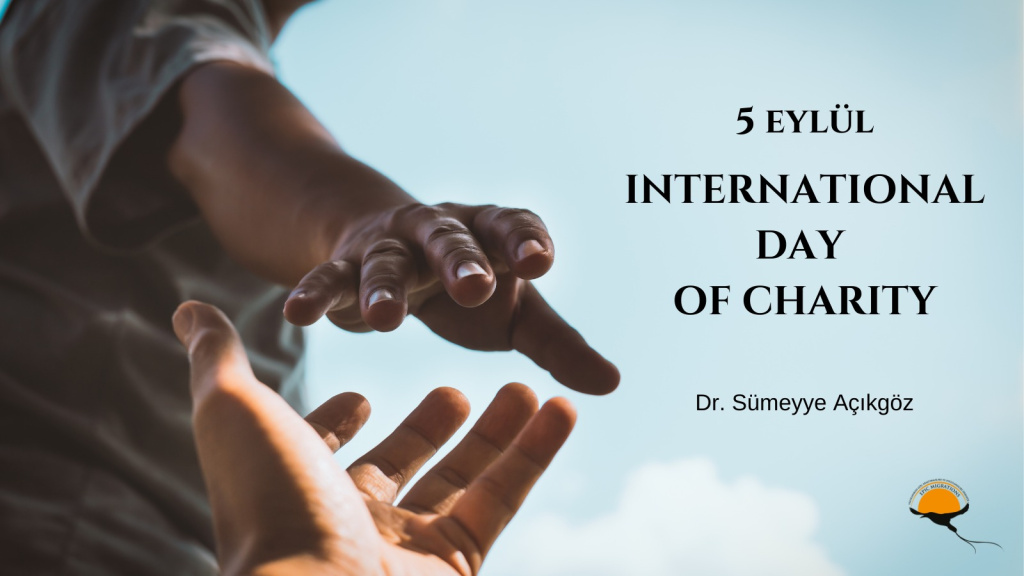
The International Day of Charity reminds us every year of a simple yet profound truth: life does not move forward without solidarity. This becomes even clearer when we talk about migration. Migrants’ stories reveal to us the most fragile face of humanity. Millions of people are forced to leave their homes because of war, poverty, political oppression, or the climate crisis. Many of them, in refugee camps or border zones, struggle to survive without access to even the most basic needs. At that very moment, charities step in, often serving as the bridge between life and death.
Yet their role goes far beyond distributing a bowl of soup or providing temporary shelter. What they offer reaches deeper. They provide psychosocial support, design programs to ensure children can access education, open language courses and vocational trainings, and above all, they give migrants a voice. For many, who lack the means to be heard in political arenas, these organizations advocate for their rights, amplify their visibility, and create public awareness. This, arguably, is as vital as food or shelter itself.
Still, the number of organizations working in the field of migration is increasing year after year. At first glance, this seems like a wholly positive picture: more organizations mean more support, right? But there is also a controversial side to this. On the one hand, diversity is beneficial because each organization can specialize: some in health, others in education, others in housing. Small local associations can respond quickly to immediate needs, while large international organizations can mobilize wide-reaching resources. The multiplicity of actors also spurs innovation, encouraging more creative and sustainable approaches.
On the other hand, the presence of so many actors brings challenges. Resources often become fragmented; donations and funds get dispersed across dozens of organizations, sometimes preventing depth in a single area. Coordination problems are also common: in one region, identical services may be provided repeatedly, while in another, people are left completely unattended. One family may receive three food packages, while another goes hungry. Competition for visibility or donations can even overshadow the actual needs of migrants.
This is why the real necessity is not rivalry, but complementarity. Organizations must stop viewing one another as competitors and instead act as pieces of a single ecosystem. Where coordination is strong, assistance becomes far more effective. Joint platforms, collaborative mechanisms, and co-designed projects leave a much more lasting impact on migrants’ lives. After all, the issue is not who is most visible, but who truly makes a difference.
The International Day of Charity, therefore, is not only a day to give, but also a day to open up these discussions, to identify shortcomings, and to expand solidarity. It is clear that charities alone cannot solve the structural problems of migration. Real solutions require political will from states and international actors. But this fact does not diminish their role. On the contrary, their presence reminds migrants they are not alone. A child able to go to school, a woman sleeping in safety, a young person gaining a skill and stepping into a new life—all of these are concrete reflections of charity.
Ultimately, charity is not merely an act of kindness but also a reckoning of conscience. Supporting migrants is not only about securing their future, but about preserving our shared future. To improve the lives of migrants is, in truth, to improve humanity itself. At EpicMigrations, we see charity not just as distribution of aid, but as raising awareness, defending rights, and expanding solidarity. Standing with migrants is, in essence, standing with humanity.
