
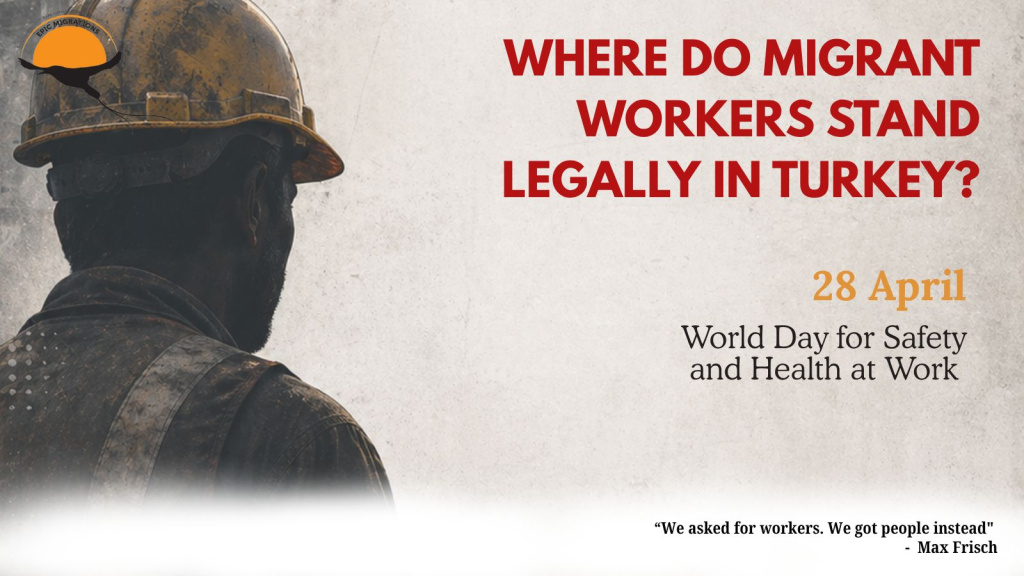
“We asked for workers. We got people instead”
– Max Frisch
Generally, migrant workers, as a sub-group of the broader category consisting of women, children, persons with disabilities, the elderly, and migrants—who are among the groups in disadvantaged positions—carry multiple vulnerabilities arising both from being migrants and from their status as workers, and are situated within a more intense and multi-layered sphere of disadvantage in terms of the risks they face. In particular, the World Day for Safety and Health at Work on 28 April, which has been observed at the international level since 2003 to commemorate those who have lost their lives in occupational accidents, necessitates a separate assessment, within this framework, of the extent to which occupational health and safety regulations are effectively implemented with regard to migrant workers.
First of all, an examination of the adoption of the relevant day and of the conventions of the International Labour Organization, to which the Republic of Türkiye has been a party since 1932, reveals that the labour shortages created in production processes due to the human demand during both world wars in the first half of the twentieth century affected global mobility and marked a turning point in migration movements. However, these ‘guest’ workers, who formed part of the production process, were not the hosts of nation-states; for this reason, they were generally deprived of adequate protection by states in terms of working conditions, access to social rights, and occupational health and safety, and were consequently subjected to discrimination.
Observing in practice the severe consequences brought about by such discrimination, the International Labour Organization, with the aim of emphasizing that international labour standards apply to all workers regardless of nationality or migration status, unless otherwise expressly stated, first adopted the Migration for Employment Convention No. 97 of 1949, and subsequently the Migrant Workers (Supplementary Provisions) Convention No. 143 of 1975, which complements the former, thereby seeking to regulate labour migration, protect the rights of migrant workers, and promote non-discrimination and equal treatment among member states.
Similarly, “However, pursuant to Article 11 of the conventions, a ‘migrant worker’ is defined as a person who migrates or has migrated from one country to another for the purpose of employment other than on their own account, and who is regularly admitted as a migrant worker. In this respect, it appears that the obligation imposed on states by the relevant provisions to ensure social security is granted only to workers holding a work permit, whereas those without such authorization are excluded from this protective framework. Furthermore, the fact that these conventions have been ratified by only 54 and 30 countries respectively, in some cases subject to reservations, indicates that these regulations remain limited both in scope and in their global reach.
Türkiye, which has maintained an active relationship with the International Labour Organization since 1932 and currently keeps 55 out of the 59 conventions it has ratified in force, has not yet ratified the aforementioned conventions as of the date of this study. From an international perspective, the instruments to which the Republic of Türkiye is a party include the Universal Declaration of Human Rights, the Convention Relating to the Status of Refugees, and the Convention Relating to the Status of Stateless Persons, which contain indirect provisions concerning migrant workers, as well as the United Nations International Convention on the Protection of the Rights of All Migrant Workers and Members of Their Families, which provides for provisions directly addressing migrant workers. By virtue of this latter convention, which also extends its protection to irregular migrants, states parties are encouraged to take measures aimed at safeguarding the rights of migrant workers, ensuring consistency in implementation, and preventing the smuggling of workers.
Under the current conditions, the primary legal sources governing the occupational health and safety of migrant workers are, first and foremost, international agreements concluded between states parties. Indeed, such agreements often give rise to reciprocal rights and obligations for the states concerned, frequently on the basis of reciprocity; this, in turn, leads to variations in the scope of protection afforded to migrant workers depending on the legal relationship between the relevant states. In this respect, it is evident that the protection relating to occupational health and safety does not, in all circumstances, possess a uniform and comprehensive character.
In this respect, the occupational health and safety rights of migrant workers are primarily regulated under Law No. 6331 on Occupational Health and Safety in a manner that encompasses all employees irrespective of their citizenship status. Indeed, the said Law applies to all workplaces without distinction between the public and private sectors and imposes on employers the obligation to ensure the health and safety of employees, to prevent occupational risks, and to provide the necessary training. Within this framework, migrant workers are considered among ‘groups requiring special policy measures’ due to language and integration-related challenges, and the Law imposes upon employers the duty to structure their risk assessment and training obligations accordingly.
Furthermore, the employer’s duty of care regulated under Article 417 of the Turkish Code of Obligations No. 6098 encompasses the protection of the employee’s personality as well as the adoption of occupational health and safety measures. This obligation does not cease to exist even where the employee is a foreign national or lacks a work permit; on the contrary, it is accepted in both doctrine and case law that the employer’s liability persists, particularly with regard to migrant workers engaged in undeclared employment. In this respect, although the provision is of a general nature, it effectively extends to cover undeclared work in practice and thus evidently provides a broader and more inclusive sphere of protection compared to the conventions of the International Labour Organization.
Moreover, Law No. 6735 named the International Labour Force also provides for specific regulations, particularly concerning the work permits of migrant workers and the related social security obligations. Pursuant to the said Law, employers who employ migrant workers are required to fulfil their obligations arising from social security legislation, and administrative sanctions are предусмотрed in cases where migrant workers are employed without a valid work permit. Furthermore, it is accepted that, even in respect of migrant workers employed without a work permit who suffer an occupational accident, the employer’s obligation to cover healthcare expenses and other necessary costs continues to apply.
Nevertheless, it is difficult to assert that this broad scope of protection envisaged at the normative level is equally reflected in practice. Indeed, it is frequently observed that migrant workers employed in sectors such as construction, agriculture, and textiles—where undeclared employment is prevalent—are engaged in heavy and hazardous work without adequate occupational health and safety measures. Incidents reported in the media indicate that migrant workers are exposed to occupational accidents, that their living and working conditions may reach levels incompatible with human dignity, and that in some cases they are subjected to violence and ill-treatment. This situation clearly demonstrates the need for more effective, regular, and comprehensive inspections of migrant workers’ working conditions by the labour inspectors.
In conclusion, when the protection regime concerning the occupational health and safety of migrant workers is evaluated in light of both international conventions and the regulations embodied in Turkish law, it is evident that, while a broad framework is provided at the normative level, this framework is not implemented with the same level of effectiveness in practice. The limited scope of the International Labour Organization conventions, the relatively low number of ratifying states, and their reciprocity-based structure hinder the establishment of a uniform and comprehensive level of protection for migrant workers; by contrast, the regulations set forth under Law No. 6331 on Occupational Health and Safety, the Turkish Code of Obligations No. 6098, and Law No. 6735 on the International Labour Force provide a broader sphere of protection for migrant workers, including those engaged in undeclared employment. Nevertheless, practical instances—particularly in sectors where undeclared employment is prevalent—demonstrate that migrant workers are often employed under heavy and hazardous conditions without adequate occupational health and safety measures, and that even their most fundamental rights, such as housing, nutrition, and personal security, may be violated, thereby clearly revealing the gap between norm and reality. In this respect, it is not sufficient for the occupational health and safety rights of migrant workers to be recognized merely at the legislative level; rather, it is imperative to render such protection tangible and effective through the implementation of efficient and regular inspection mechanisms, the combatting of undeclared employment, and the effective realization of the principle of equality. Within this framework, we commemorate Mohammed Nourtani—who had malady while working in an unlicensed mine and was burned alive in an attempt to conceal the illicit operation—as well as all migrant and citizen workers who have suffered from occupational accidents or occupational diseases, on the occasion of 28 April.
SOURCES
- Akyıldız, C. (2022). “Avrupa Birliğine Katılım Sürecinde Türkiyedeki Dezavantajlı Çalışan Gruplarının İş Sağlığı ve Güvenliği Faktörlerinin İncelenmesi.” Erciyes Akademi, 36(4), 1739-1765. https://doi.org/10.48070/erciyesakademi.1129472.
- Civan, O. E., & Gökalp, A. (2011). “Göçmen İşçi Kavramı ve Göçmen İşçilerin İş Sağlığı ve Güvenliği.” Çalışma ve Toplum, 1(28), 233-264. https://izlik.org/JA49GA76AE.
- Demirci, K. (2019). “Tüm Göçmen İşçilerin ve Aile Fertlerinin Haklarının Korunmasına Dair Uluslararası Sözleşme ve Türkiye’nin Mevzuat Bakımından Sözleşmeye Uyumu.” Mersin Üniversitesi Sosyal Bilimler Enstitüsü Dergisi, 2(2), 6-16. https://izlik.org/JA64DM49GN.
- Kılınç B. (2025), Türk Sosyal Güvenlik Hukukunda Yabancılık Unsuru. Yetkin Yayıncılık.
- Tellal, E. (1994). “Göçmen İşçiler, Yaşam Koşulları ve Son Uluslararası Sözleşme.” Ankara Üniversitesi SBF Dergisi, 49(03). https://doi.org/10.1501/SBFder_0000001722.
- Yıldırım, O., Altunoğlu, M. K., Geyik Yıldırım, S. (2023). “Suriyeli Göçmen İşçilerin İş Sağlığı ve Güvenliğini Etkileyen Faktörler.” Kafkas Üniversitesi Sosyal Bilimler Enstitüsü Dergisi, 31, 267-287. https://doi.org/10.56597/kausbed.1245396.
- Yılmaz, G. (2005). “Emek Göçünün Tarihsel Arka Planı AB’deki Göçmen İşçilerin Durumu.” TTB Mesleki Sağlık ve Güvenlik Dergisi, 6(23), 2-7. https://izlik.org/JA35UU36AJ.
